Getting Gritty in the Southwest: Zion, Bryce, and the Paria Plateau
A Voyant print is a distillation of stillness earned through physical volatility. In the pursuit of what we call the Art & Gravity of Presence, the mission is to capture “obsidian” anchors and “glowing” light that serve as meditative tools for high-performance minds.
My recent production tour through the American Southwest was a dedicated scouting mission to find these moments of symmetric balance amidst shifting environmental extremes. To bring these landscapes to the Voyant collection, we don’t just observe the terrain. We endure it.
Zion: The Altitude of Perspective
The journey began with an intentional shift in perspective. On Tuesday, April 7th, we took to the sky at 7:30 AM for a private 55-mile flight over the Zion boundary.
Floating above Smithsonian Butte, the goal was to isolate the deep, contemplative shadows — the “obsidian” anchors — that provide a sense of gravity in a composition. As the early light struck the West Temple, it revealed elusive textures that define our Master Resolution standards. This wasn’t merely photography. It was a ritual of observation, capturing the raw emotional depth of the stone as it met the morning sun.
Bryce Canyon: 28 Degrees and Deep Time
True mastery requires the patience of slowness and the endurance of the cold. On Wednesday, April 8th, the production moved to the rim of Bryce Canyon.
The Environment: We stood at the rim (elevation ~9,100 ft) at 4:45 AM. The air was a static 28°F, turning every breath into a visible mist that threatened to frost the lens.
The Subject: The 50-million-year-old Claron Formation hoodoos. Standing in the biting air as the sun crested the horizon, the orange glow reflecting off the high-altitude ice offered a profound invitation to pause.
The Technique: Using the Canon R5 to capture the intricate, glowing patterns of the spires against the sunrise, we sought to anchor that feeling of calm into a single frame.
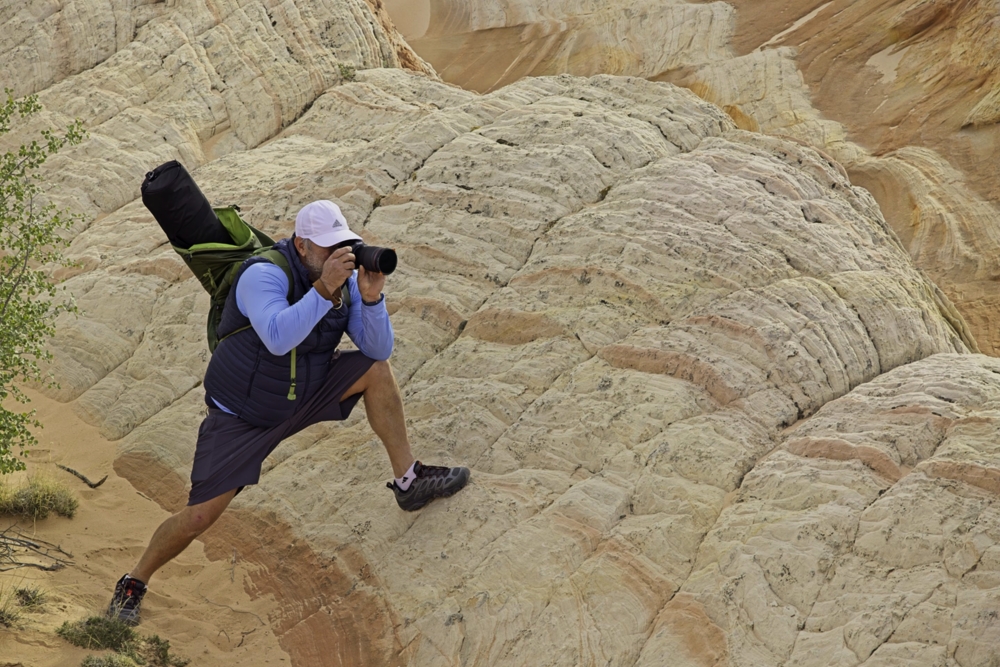
White Pocket: Grit, Rain, and Ancient Tracks
The tour’s final phase required navigating the deep, unmaintained sand of the Paria Plateau. Getting to White Pocket is a study in rough terrain. It requires a specialized 4WD approach that keeps the mind sharp and the body alert.
As we reached the “brain rock” formations, a sudden desert rainstorm moved in, soaking the landscape and our gear. In this extreme, the white and red swirls of the Jurassic-era stone took on a saturated depth that only exists in the wake of a storm. Scouting the 200-million-year-old dinosaur tracks embedded in the Kayenta layers amidst a downpour creates a profound sense of grounding. In short, a Voyant anchor is a connection to a timeline much larger than our own.
From Grit to Gravity
The final 60-inch Lumachrome® print — with its surgical sharpness — belies the physical cost of its creation. We lean into the icy cold, the rain, and the 4:00 AM alarms because the “glowing” resonance of these remote places cannot be manufactured in a studio.
When you stand before these works, you are seeing the result of that transition: from the volatile grit of the terrain to the absolute gravity of presence.
Field Production Specifications
Environmental low: 28°F (Bryce Canyon, 9,100 ft)
Terrain navigation: High-clearance 4WD, deep sand, Paria Plateau
Geological scale: 50M-year hoodoos, 200M-year theropod tracks
Primary capture: Canon EOS R5 Mark II
Visual goal: Symmetric balance with a central “obsidian” anchor
Print standard: 60-inch Lumachrome® Master Resolution
Resolution: 300 PPI via Resize AI
Color space: ProPhoto RGB (16-bit TIFF)
Sharpening: Capture sharpening via Tack Sharp AI
Noise profile: NoNoise AI for shadow purity
Works available May 1st, 2026


